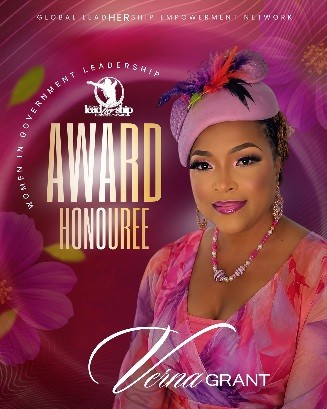
Award Honouree

Verna
Grant

A testament to the enduring power of Bahamian women in the halls of governance.

Global Leadership Empowerment Network · Women in Government Leadership Award

Portrait tribute to Verna Grant

Yes, they can!

We salute the achievements of Verna Grant in her role of engaging politics in the Bahamas. She showed us how — and why — to forge change in our homeland, in our quest to make the Bahamas a better place to live, work and play.

Her story is pivotal to a longer, harder anecdote: the story of women in Bahamian politics. It is a story of a straight line of progress that bent, and of a table where, for far too long, the seats meant for our women stood empty.

The Long Walk to Equality

1919

United Kingdom Suffrage

The Representation of the People Act grants UK women the right to vote, sparking hope across the British Empire.

1920

The US 19th Amendment

Ratification in the United States establishes that the right to vote shall not be denied on account of sex.

1961

Bahamian Women's Suffrage

After a 43-year wait, Bahamian women win the right to vote, casting their first ballots in the 1962 General Election.

1973

Independence Constitution

Twelve men — eleven lawyers and one bishop — negotiate the new constitution in London. No women at the table. Bahamian women lose the right to pass citizenship to their children.

3×

Failed Referenda

Three separate referenda to correct the gender-citizenship injustice have failed, some by margins as wide as two-to-one.

“
Have a seat at the table or find yourself on the menu.
A guiding principle of the movement

A history worth naming

The Bahamas was a dependent member of the British Empire, yet our women did not gain the right to vote until 1961 — a basic citizenship right curtailed for 43 years.

The most egregious moment came later. In 1973, twelve men — eleven lawyers and one Anglican bishop, zero women — travelled to London to negotiate the Bahamian Constitution ahead of independence. The document they returned with stripped away the right for Bahamian women to pass citizenship to their children.

Fifty-three years on, three separate referenda have tried to remedy that injustice. All three have failed, sometimes defeated by margins as wide as two-to-one.

A Collective Reckoning

To the daughters of the Bahamas: we recognize the delays and the closed doors of our history. Our apology is not found in words alone, but in the relentless pursuit of a table large enough for everyone. The only way to change society is to start with those ready, willing and able to present themselves to forge change — those who have not given up.

Read the full essay